
This page is full of resources to help you deepen your knowledge of ultra processed foods or nutrition in general. It is a great way to really get behind your choices – to understand why you are doing it.
Books on Ultra-Processed Foods and Nutrition
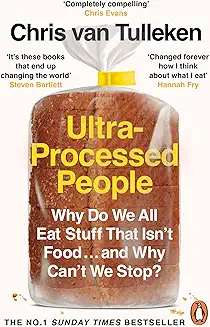
Ultra-Processed People: Why Do We All Eat Stuff That Isn’t Food?” by Chris van Tulleken
A must-read for anyone looking to understand how the food industry has shaped our eating habits. Dr. van Tulleken explains how UPFs dominate modern diets, impacting both health and the environment.
**
– A must-read for anyone looking to understand how the food industry has shaped our eating habits. Dr. van Tulleken explains how UPFs dominate modern diets, impacting both health and the environment.
2. **”In Defense of Food: An Eater’s Manifesto” by Michael Pollan**
– Pollan’s famous call to “Eat food, not too much, mostly plants” is particularly relevant when thinking about UPFs. He explores how industrial food production has altered what we eat.
3. **”Salt, Sugar, Fat: How the Food Giants Hooked Us” by Michael Moss**
– This investigative book uncovers how major food companies have manipulated the public into consuming more UPFs by exploiting our addiction to salt, sugar, and fat.
4. **”Hooked: Food, Free Will, and How the Food Giants Exploit Our Addictions” by Michael Moss**
– A fascinating look at the food industry’s deliberate engineering of ultra-processed foods to trigger cravings and overconsumption.
5. **”The Case Against Sugar” by Gary Taubes**
– While this book focuses on sugar, a key ingredient in many UPFs, it offers a deeper understanding of how certain ingredients have contributed to widespread health issues.
—
### **Documentaries on UPFs and Food Industry**
1. **”Fed Up” (2014)**
– This eye-opening documentary focuses on the role of sugar in the obesity epidemic and how processed food industries have manipulated information for decades.
2. **”That Sugar Film” (2014)**
– A documentary by Damon Gameau that follows the effects of consuming the equivalent of 40 teaspoons of sugar a day, all through processed and ultra-processed foods.
3. **”The Magic Pill” (2017)**
– While primarily about the benefits of a ketogenic diet, this documentary also explores how reducing processed foods can lead to significant health improvements.
4. **”Processed People” (2009)**
– This film highlights the dangers of processed and ultra-processed foods and the societal shift that has led us to rely heavily on these products.
5. **”Forks Over Knives” (2011)**
– Though more focused on whole-food plant-based diets, this documentary touches on the negative effects of processed and ultra-processed foods on human health.
—
### **Research and Articles on UPFs**
1. **”Ultra-processed foods and human health: what do we already know?” – BMJ (2023)**
– A comprehensive overview of the current research linking UPFs to various health issues, including obesity, diabetes, and heart disease.
[Read here](https://www.bmj.com/content/372/bmj.n111)
2. **”The association between consumption of ultra-processed foods and all-cause mortality: A systematic review” – JAMA (2020)**
– This research provides strong evidence for the link between ultra-processed food consumption and increased risk of mortality.
[Read here](https://jamanetwork.com/journals/jama/fullarticle/2762608)
3. **”Processed Foods: Contributions to Nutrition and Public Health” – Public Health Nutrition (2019)**
– Explores the balance between processed food contributions to public health versus the risks posed by UPFs.
[Read here](https://www.cambridge.org/core/journals/public-health-nutrition/article/processed-foods-contributions-to-nutrition-and-public-health/)
4. **SACN Report on Processed Foods and Health (2023)**
– The UK’s Scientific Advisory Committee on Nutrition investigates the link between processed foods and health outcomes.
[Read the report here](https://www.gov.uk/government/publications/sacn-report-processed-foods-and-health)
—
### **Apps and Tools to Help You Avoid UPFs**
1. **Yuka**
Scan food products and see detailed information on their nutritional quality, additives, and level of processing. This app makes it easy to identify UPFs while shopping.
2. **FoodSwitch UK**
Designed to help consumers make healthier choices by providing healthier alternatives to the foods they scan. The app highlights processed and ultra-processed ingredients.
3. **Noom**
While primarily a weight-loss app, Noom’s approach to psychology-based nutrition can help users identify UPFs in their diet and make sustainable food swaps.
4. **MyFitnessPal**
Track what you eat and get insights into how much of your diet is made up of processed and ultra-processed foods.
5. **Open Food Facts**
An app with a massive database of food products that allows users to see how processed foods are and find healthier alternatives.
—
### **Podcasts on Ultra-Processed Foods**
1. **”Real Food Chain” (BBC Radio 4)**
A fantastic series on how our relationship with food has changed over time, with episodes on processed and ultra-processed foods.
2. **”Eat This Podcast”**
Delves into the history of food processing and explores modern food issues, including the rise of UPFs and their effects on health.
3. **”The Doctor’s Kitchen Podcast”**
Dr. Rupy Aujla discusses how food affects health, with several episodes touching on the risks of ultra-processed foods.
—
### **More Helpful Links**
– **[NHS: Eat Well Guide](https://www.nhs.uk/live-well/eat-well/)** – A great resource for understanding how to balance different types of food and avoid UPFs in the context of a healthy diet.
– **[British Heart Foundation: Healthy Eating](https://www.bhf.org.uk/informationsupport/support/healthy-living/healthy-eating)** – Tips for reducing processed foods and making heart-healthy choices.
– **[World Health Organization (WHO): Processed Food Recommendations](https://www.who.int/news-room/fact-sheets/detail/healthy-diet)** – The WHO’s recommendations for limiting processed and ultra-processed foods as part of a healthy diet.
—
### **Conclusion**
Reducing your intake of ultra-processed foods is an empowering step toward a healthier lifestyle. Whether you prefer reading books, watching documentaries, or using apps, these resources will help you make informed choices about the foods you consume. Bookmark this page and refer back to it whenever you need a boost in your journey to ditch UPFs!